
This is the last of a series of short videos taken at the Wines of South Africa Mega Tasting held in London in October.
Showing posts with label southern right. Show all posts
Showing posts with label southern right. Show all posts
03 November 2009
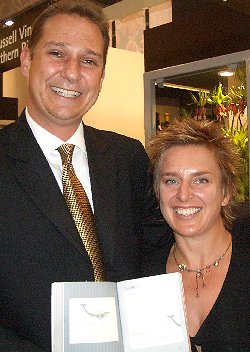
Southern Right Pinotage with owner Anthony Hamilton Russell (video)
Anthony Hamilton Russell is a passionate fan of Pinotage which he produces under two labels: Ashbourne and Southern Right. Here he talks about his belief in the variety, how it ages and how he is redefining Pinotage.
This is the last of a series of short videos taken at the Wines of South Africa Mega Tasting held in London in October.
This is the last of a series of short videos taken at the Wines of South Africa Mega Tasting held in London in October.

16 June 2009
Pinotage in the Blogs....
Andrew Barrow of Spittoon has posted a report of his recent visit to Beyerskloof. He says
He also enjoyed the Pinotage Burger! See his report here
Peas on Toast doesn't seem to have heard of the worldwide airport ban on liquids in hand baggage and had two bottles of Diemersfontein Pinotage confiscated, an act that
Diemersfontain Pinotage was the secret ingredient that helped the Cherryflava team in South Africa win first place in their annual potjiekos competition.
Mike Rosenberg at Naked Vine released his inner Shatner trying the Golden Kaan range. He paired the Pinotage 2006 and Shiraz 2007 with a spiced lamb dish and found that
And Yoav Shapira was pleasantly surprised by Souther Right's 2007 Pinotage The 2007.
While age worthy it is the younger Pinotage single varietals that impressed during the cellar tasting. With ripe, sweetish upfront fruit, good structure and length they have structure and drinkability with the Beyerskloof Reserve Pinotage being singularly impressive.
He also enjoyed the Pinotage Burger! See his report here
Peas on Toast doesn't seem to have heard of the worldwide airport ban on liquids in hand baggage and had two bottles of Diemersfontein Pinotage confiscated, an act that
was nothing short of the most sacrilegous sacrilege on the planet.Her friends in Istanbul will be disappointed but at least the airport security team had something decent to drink with their dinner.
Diemersfontain Pinotage was the secret ingredient that helped the Cherryflava team in South Africa win first place in their annual potjiekos competition.
We made our famous lamb and mushroom pot, laced with a bottle of DiemersfontainPinotage and fresh organic ingredients.
Mike Rosenberg at Naked Vine released his inner Shatner trying the Golden Kaan range. He paired the Pinotage 2006 and Shiraz 2007 with a spiced lamb dish and found that
the Pinotage was much more interesting. I thought it stood up to the spices in the marinade and the sauce, and the flavors in the wine itself stood out.
And Yoav Shapira was pleasantly surprised by Souther Right's 2007 Pinotage The 2007.
I expected it to be more blunt, since it's so young. But it was very smooth.
Almost too smooth.
31 May 2008
Decanter Trophy for Kanonkop
 Kanonkop Pinotage 2004 won the Decanter 2008 World Wine Awards 2008 Trophy for 'South African Red Single Varietal Over £10' and Southern Right's 2006 Pinotage won the only Gold medal awarded to Pinotage. Another 36 Pinotages won awards (9 Silvers, 16 Bronzes, 11 Commendeds). Six Cape Blends won awards, 1 Bronze and 5 Commended. Kanonkop are also celebrating winning the Trophy for 'Red Bordeaux Varietals over £10'. Award details are here.
But the picture is not so bright over at the International Wine Challenge where 28 Pinotages gained Bronze and Commended awards, and a solitary Silver was won by Majors Hill 2006. Award details are here.
Congratulations to them all.
17 December 2007
Pinotage -- South Africa's Home-Grown Identity
 “Pinotage is not merely a European grape transplanted to a new hemisphere. It's a native [which] could establish South Africa not only as a major winegrowing region but also as a region with a home-grown identity,” says Lolis Eric Elie in New Orlean’s ‘Times-Picayune’, adding “If only the grape could make good wine consistently.”
On a recent trip to South Africa, Elie “did a blind tasting of several bottles of Pinotage and one Pinotage blend. I tried to include all of the versions of Pinotage available in New Orleans these days. There are not many.”
Zonnebloem 1997 Pinotage was the favourite. “The nose was very much like what you'd expect in an Amarone: prunes and old leather. The fruit had all but subsided, leaving a hint of red berries, but mostly dark, dried flavors and slight petroleum perfume. This wine demonstrates how better Pinotage can age for a decade or so, but even by the end of the tasting this wine was losing its structure, leaving behind bright, almost sour flavors. At 12.5 percent alcohol, it exemplifies the taste of Pinotage made in the Old World, European style.”
Morkel's 2005 Bellevue Estate “exemplifies the other, newer approach to Pinotage. The wine spends 12 months in American oak barrels. From this wood, it gets an eggnog scent on the nose. It is well balanced with ripe tannins and a little acidity. Though it's 14.5% alcohol, the flavors are so integrated as to not be overpowering.”
Elie remarks on the differing styles found in the tasting – “there's another dichotomy besides the Old World vs. New World, austere vs. powerful debate. The grape can produce highly tannic, acidic wines that taste sharp and harsh, like a bad Sangiovese. But it also can produce light, berrylike wines that resemble nothing so much as a Beaujolais. Those two wines have nothing in common and, it would seem, the two visions of Pinotage they parallel have little in common from a flavor perspective also.”
Graham Beck’s 2007 Pinno from “has 14.5% alcohol, but it is not a big, powerful wine. It's full of strawberries and driven more by acidity than tannins. It's a good, crowd-pleasing party wine,” and Uiterwyk's DeWaal 2005 Pinotage “parallels the nutmeg and Beaujolais flavors of the Pinno. It has nice, soft tannins, with tart cherry flavors on the front end and a bit of tar on the finish. It has 14% alcohol.”
But Southern Right’s 2005 Pinotage got the thumbs down being “full of smoke on the nose, and every bit of its 14% alcohol level was evident from the initial whiff, turning into harsh tar on the tongue, overpowering the fruit flavours,” and Fleur du Cap’s 2006 Pinotage also failed to please because while its “combination of flavors is interesting, they were not especially tasty.”
Elie has a refreshingly positive take on Pinotage and the full article, which is online here , is well worth reading.
As Elie says -- “So much rides on the shoulders of Pinotage.”
20 July 2007
Tanzer's 90 Pointer Pinotage
Southern Right Pinotage 2005
American critic Stephen Tanzer, writing in Issue 131 of International Wine Cellar, (March/April 2007) said
"Bright, saturated ruby-red. Aromas of crushed blackberry, mulberry and minerals, with a medicinal suggestion of band-aid. Then dense and vibrant, with excellent intensity to the slightly high-toned crushed berry and spice flavors. Plenty of incipient complexity here, but this dry, fruit-driven pinotage needs a couple years in the bottle. Finishes very long and spicy, with a sexy note of woodsmoke. 90 points" ($18 at Vinfolio.com)
Did he say band-aid? Sounds like brett to me, but I suppose as long as it has a sexy finish........
American critic Stephen Tanzer, writing in Issue 131 of International Wine Cellar, (March/April 2007) said
"Bright, saturated ruby-red. Aromas of crushed blackberry, mulberry and minerals, with a medicinal suggestion of band-aid. Then dense and vibrant, with excellent intensity to the slightly high-toned crushed berry and spice flavors. Plenty of incipient complexity here, but this dry, fruit-driven pinotage needs a couple years in the bottle. Finishes very long and spicy, with a sexy note of woodsmoke. 90 points" ($18 at Vinfolio.com)
Did he say band-aid? Sounds like brett to me, but I suppose as long as it has a sexy finish........
05 February 2007
No Weedy Wines Here!

2001 Hidden Valley Pinotage is one of the Pinotages that are stocked by the Ontario monopoly LCBO and thus available to Gordon Stimmel of the Toronto Daily Star who finds Pinotage 'weedy', see here
I opened my only bottle of this wine and found it had a dense garnet colour, with a little smokiness on the nose and front palate, but with a core of concentrated dense red fruits - black cherry and mulberry , a there is a little spice and tobacco and some soft drying tannins on the finish. Lovely stuff.

Hidden Valley's vineyards are in Devon Valley, access to which is along a no-through road that terminates at JC le Roux Sparkling Wine Cellars. Along that road is the sign shown here on the left. It always amuses me that there is such a large sign for a hidden valley. But the name comes from the owner of the vineyard and winery owner, Dave Hidden.
Some other Pinotages I've had recently were
2005 Southern Right Pinotage - Little staining of glass, light bodied and a tangy finish. This is an almost delicate wine with purity of fruit, certainly no block buster and seems like Burgundy is the inspiration.
2005 Groot Constantia Pinotage - There's a European feel to this wine, quite restrained with a good balance of red plum fruits and tannins and a very long finish.
2001 Bellevue Estate Pinotage - Black dense cherry and blackberry fruit flavours, tobacco underneath, hint of eucalyptus and with a very long finish. A very enjoyable serious wine made from 58 year old bush vine grown on sandy soil, aged 10 months in 50% new 300l American oak barrels. 13.5% abv. ABSA Pinotage Top 10 winner in 2002.
02 February 2007
Ashbourne -- Same Same?
 Rarer than hens teeth, more tasted and talked about than drunk, 2007 sees a new vintage of Ashbourne released. The first was the 2001 vintage, now along comes 2004. Have I tasted it? Heck no -- none had arrived in the country in time for their recent UK agents tasting.
But South African food and wine writer JP Rossouw went to the Hamilton Russell Vineyards launch earlier this month. He writes in his blog "The 2004, to my palate, reminds me much more of pinotage, with more primary fruit. I would be surprised if this wine does as good a job of being the “fine wine without an obvious mother” that the 2001 was. Fuller fruit expression with more of pinotage’s ripe winegum notes open into a wine that is again very well-styled and age-worthy, but less mysterious. And perhaps this is a very good thing for the variety."
For JP, the 2001 " is a wine that you could secretly show in the company of Bordeaux blends – indeed few pick it as pinotage. This makes it something of a Pyrrhic victory for the variety. At once a wonderful wine and one that does not taste like any other pinotage, it presents little for the pinotage mainstream to cling to and is difficult to harness for the greater marketing of the grape."
Which again raises the question, what is Pinotage supposed to taste like? Far too many people first tasted Pinotage as an old fashioned nail-varnish and bitter monstrosity, and that is what they think the variety is. When you can get them to taste a decently made wine they say, well OK, but it doesn't taste like Pinotage.
Read the Dallas Post review of Fort Ross Pinotage and ask yourself if you'd guess the wine in question was Pinotage just by reading the review on its own. Why don't California and New Zealand Pinotages suffer from bitterness and nail varnish flavours?
Asbourne is a project by Anthony Hamilton Russell who firmly believes in Pinotage and the wine is unusual in that it doesn't name a grape variety. Anthony wants people to judge the wine on its merits.
JP remarks on a stylistic difference between the 2001 and 2004 Ashbournes, and I wonder if this old news item holds the answer. "An impressive flagship Ashbourne 2001 is made from 100% Pinotage from HRV’s Bastenburg vineyard. But grapes will be sourced from Southern Right’s site from the 2004 vintage." (Kim Maxwell writing on www.wine.co.za)
*and frequently Ashbourne is kept under the table and poured only for the great and good.
18 December 2004
Bath University Pinotage Tasting
Professor Keiran Molloy at the University of Bath organised a Pinotage tasting for the University Staff Wine Society. He writes " Thank you for your help on the tasting, which was extremely successful and well received. You have converted a lot of people to Pinotage, and personally I will be stocking up on the Stellenzicht, L'Avenir and Kanonkop (which was far more approachable even at this stage than I had expected)".
His notes with "an unscientific marking of each wine out of 10, which reflects relative rather than absolute merit" follow.
.
His notes with "an unscientific marking of each wine out of 10, which reflects relative rather than absolute merit" follow.
Southern Right 2002 - The lightest of all the wines tasted. Bright red colour, mix of red and black fruit flavours, full flavour in mouth, short on finish. An uncomplicated wine that won't disappoint but is unmemorable. No noticeable tannins so a wine for drinking now rather than keeping. (5.5/10)
Flagstone Writers Block 2002 - Mid-red colour, light tannins, sweetish red fruit flavours with a smokey finish. More body and slightly longer in the finish than Southern Right. A popular wine for immediate drinking. (7/10).
Groot Constantia Estate 2001 - Similar in colour to the Southern Right. Darker fruit flavours becoming more apparent than the earlier two wines. Full flavour in mouth but again short on finish. Earthy flavours, with smoke/tar finish. A more lively wine than the opening pair with more of a zing. By the end of the tasting, after being open for about 3h, this wine developed pronounced southern Rhône flavours becoming reminiscent of a Gigondas and far more complex in nature (6/10, based on early evening opinion)
Bellevue Estate 2000 - Deep red colour with well integrated tannins. This is a far more complex wine and would work better at this stage in its life with food. There is a hint of eucalyptus on the nose and nice mixed red/black fruit flavours. Other tasting notes suggested this was a controversial "new age" wine but that was not the opinion of the group. Good value for money as the cheapest wine in the tasting. (7/10)
Stellenzicht Golden Triangle 2000 - Deep red colour with purple hue. Obvious and yet soft tannins which are well balanced with the fruit, this is a wine which is drinking well now (perhaps better with food) but a long and exceptional future ahead of it. A long, full mouthful of plums and black fruit flavours. (7.5/10)
Neethlingshof Estate Lord Neethling 1998 - The most controversial of the wines presented. Dry tannins with less weight of fruit than the Stellenzicht. Mid-weight fruit overall, plum, blackcurrant and mulberry flavours with a slightly smokey edge. The fruit/tannin balance is not as good as Stellenzicht, and the wine has a sharp, spicey, slightly burning finish with met with divergent reaction. (7.5/10 but some much higher, some much lower )
L'Avenir Estate 2002 - The most popular of the wines tasted, drinking perfectly now but with enough soft tannins to ensure a long life. This is a very smooth wine with a hint of creamy vanilla on the nose. The flavours are of sweetish red and black fruits and there is a very long finish from this wine. Excellent. (8.5/10)
Kanonkop Estate 2001 - This wine could be described as a younger version of the L'Avenir in that it has similar characteristics but is less well evolved at this stage in its life. There is again the soft creamy flavours of oak/vanilla with loads of dark fruit flavours, but which are more hidden at this stage than for the l'Avenir. This wine became better and better with increased aeration. A wine that can be drunk with pleasure now but will be a real star in 5+ years time. (8/10)"
.
01 August 2004
Anthony Hamilton Russell Excites!
Hamilton Russell Vineyard’s reputation is built on their Burgundian style Pinot Noir and Chardonnays. For more than 20 years they’ve been recognised not only as South African icons but among the best anywhere.
But owner Anthony Hamilton Russell is also passionate about Pinotage which he releases under the Southern Right label and he will shortly announce a new Pinotage label – Ashbourne. Anthony attended our February Pinotage tasting in Cape Town and invited me to visit his cellars to taste some of his wines.
Anthony is surprising young for a major winery owner, always impeccably dressed and intense where Pinotage is concerned. “I believe so much in the potential of the variety”, he stated, “and I just wish people would put more effort into making Pinotage. It’s unique to our country and adds to the world of wine.” I mentioned WINE magazines flirtation with Shiraz. Anthony was definite that “Shiraz is not the answer for South Africa! Anyone trying to put Pinotage on the map is more innovative than those trying to rip-off Australian Shiraz.”
Hamilton Russell Vineyard’s cellar is set among his vineyards on a cliff high overlooking the town of Hermanus in Walker Bay. Part of is sunk under ground and the upper floor has doors under the eave at each end to let air circulate. Unfortunately the thatched roof was made at too low an angle and the huge supporting logs are forcing the walls apart. Underground the air is cool, the walls stained with fungus and it could be a centuries old cave in France.
In 1998 Southern Right purchased a 113 hectare farm in Walker Bay. Anthony is convinced that Pinotage needs a cool climate for slow ripening to encourage fruit complexity and tannins, and performs best on clay soils. He has identified areas of stony clay-rich Bokkeveld shale soils on the farm to plant his Pinotage vineyards. He also sources grapes from four nearby vineyards previously planted as joint ventures with the farmers.
Southern Right’s first Pinotage was the 1995 vintage. Just 162 cases were made, and the aim is to increase production to an eventual target of 10,000 cases. 2003 vintage saw 6450 cases.
Anthony says Pinotage has all the quantities to make a world class wine, and world class wines are the only ones he’s interested in making.
But owner Anthony Hamilton Russell is also passionate about Pinotage which he releases under the Southern Right label and he will shortly announce a new Pinotage label – Ashbourne. Anthony attended our February Pinotage tasting in Cape Town and invited me to visit his cellars to taste some of his wines.
Anthony is surprising young for a major winery owner, always impeccably dressed and intense where Pinotage is concerned. “I believe so much in the potential of the variety”, he stated, “and I just wish people would put more effort into making Pinotage. It’s unique to our country and adds to the world of wine.” I mentioned WINE magazines flirtation with Shiraz. Anthony was definite that “Shiraz is not the answer for South Africa! Anyone trying to put Pinotage on the map is more innovative than those trying to rip-off Australian Shiraz.”
Hamilton Russell Vineyard’s cellar is set among his vineyards on a cliff high overlooking the town of Hermanus in Walker Bay. Part of is sunk under ground and the upper floor has doors under the eave at each end to let air circulate. Unfortunately the thatched roof was made at too low an angle and the huge supporting logs are forcing the walls apart. Underground the air is cool, the walls stained with fungus and it could be a centuries old cave in France.
In 1998 Southern Right purchased a 113 hectare farm in Walker Bay. Anthony is convinced that Pinotage needs a cool climate for slow ripening to encourage fruit complexity and tannins, and performs best on clay soils. He has identified areas of stony clay-rich Bokkeveld shale soils on the farm to plant his Pinotage vineyards. He also sources grapes from four nearby vineyards previously planted as joint ventures with the farmers.
Southern Right’s first Pinotage was the 1995 vintage. Just 162 cases were made, and the aim is to increase production to an eventual target of 10,000 cases. 2003 vintage saw 6450 cases.
Anthony says his intention is to make a “quirky individual wine that some will like, but others won’t. It’s not enough to be pleasing; you have to have excite someone. Controversial wines do this”. Anthony is considering blending in a tiny – less than 2% - of Roobernet, a very new grape variety developed in South Africa by crossing the historic red-juiced Pontac and Cabernet Sauvignon.Southern Right 1995 13.18% Pinot Noir nose, deep black core, browning. Light
bodied, touch of kelp and iodine. The fruit for this wine came from Beaumont and
it was aged in new Alliers oak.Southern Right 1997 12.42%
A musty brettanomyces nose which cleared leaving a soft and attractive wine, backed with sweet fruit, light bodied and elegant.Southern Right 2002 14.34%
Bright red colour, warm coconut nose, soft bodied with light red-currant flavours.
Beautifully balanced. This has a WO Western Cape as some of the grapes were
bought in.Southern Right 2003 13.69%
Bright clear ruby colour, soft full nose, surprisingly light, enjoyably easy drinking with a long lingering aftertaste and a backbone of tannins. WO Walker Bay, from Southern Right’s own and partner vineyards.Ashbourne 2001 13.9% barrel sample
This comes the Bastenburg block. It’s a single vineyard Pinotage. It's not been racked and has a funky nose, high acids and flavours of cherry and a hint of iron, medium aftertaste, dried berries and tannins and a dry finish.
Bastenburg 2003 tank sample, not yet filtered
Exuberant purple red, immensely enjoyable quaffable wine with rich berry fruits, spicy rounded and soft, fruit tannins on the end. Anthony is looking for some “more complexity and refinement.” He doesn’t want it to go “overripe with excessive alcohol and wood.”
Anthony says Pinotage has all the quantities to make a world class wine, and world class wines are the only ones he’s interested in making.
Subscribe to:
Posts (Atom)


 Posts
Posts


